
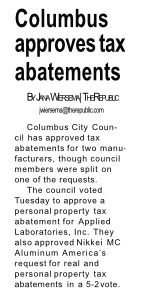
Perhaps you read the story about two local companies getting tax abatements from the city in The Republic newspaper on July 20. Or maybe you heard the term “tax abatements” somewhere else and wondered, “What exactly are those things and how do they affect me?”
Let me give you a quick look at what tax abatements are, why they’re given (or not given), how they affect the community, and where to find more information.
What are they?
An abatement is a tax break offered by a state or municipality on certain types of real estate or business opportunities. The tax break could be say, a fifty percent reduction in property taxes for a set number of years. Or it could entail a phasing in of property taxes over that time period. Most abatements expire after a predetermined number of years, at which point taxes return to their ordinary level.
The City of Columbus grants ten-year abatements for real property improvements and approves a ten-year abatement for personal property, with the exception being the downtown Economic Development Target Area, which are six-year abatements. Click here to read the tax abatement procedures followed by the City of Columbus. Procedures and laws may vary by municipality.
Why are they given?
Usually, a government only offers a tax abatement when a business or individual provides something of high value to the community. For example, a city government may give a tax break to a business in return for an investment in the city, such as a new retail location, factory, or warehouse. This provides the added benefit of increased jobs in the area.
They tend to be given to businesses that are adding good-paying jobs or have proven to be longtime valuable partners with the community. Remember the term “high value.”
Why are they not given?
Just because a business requests a tax abatement doesn’t mean it will get one. Government officials sometimes deny requests. If a company’s expansion project doesn’t bring decent-paying jobs along with it, for example, the request may not be considered “high value.” Missing out on property taxes gives the city less money to devote to services, public schools, etc.
How do they affect the community?
When used in the right situations (high value), the abated taxes are not lost revenue, since the money would not have been in the city coffers had the development not occurred. However, used in the wrong situations (low value or to companies that don’t really need them), the city is deprived of income it would have had without the subsidy. This is money that would otherwise have gone to fund city services.
How to decide?
City council members must take into account all information regarding an abatement request to decide whether to approve or deny it. How many jobs are expected to be added? How much will these jobs pay? How successful is this company likely to be? How many employees does it currently have? Will it expand elsewhere (or even close up shop and move) if not given the abatement now? Will local contractors lose business if the company can’t afford to complete a project without the abatement? And if so, is this of major consequence to the city? What their voting on is , “Will our community be better off if we give this tax abatement or will it be worse off?” As was the case with one of the abatements approved at the last city council meeting, not all members are going to be in agreement every time. It’s a case-by-case basis.
My take
Giving away tax abatements like candy hurts the community. Not giving any at all does the same. Granting some abatement requests are no-brainers. Solid companies entrenched in the community employing a bunch of people at good wages that have expanded before and are likely to continue to succeed. You want to keep that company here and succeeding, and you expect that. That’s good gamble.
Then, there are other requests where the gamble isn’t as sure.
As I listened to the presentations from Applied Laboratories Inc. and Nikkei MC Aluminum America, it was easy for me to say, “Applied Labs? No-brainer. Yes.” Council agreed, unanimously. However, I was torn when hearing Nikkei’s presentation and the debate that followed. The abatement passed, 5-2, and I saw good points being made by both sides.
Not having had all the information at my disposal that the council did at the time, I can’t say how I would have voted had I been tasked with that duty. I was kind of leaning one way. But that’s the thing: you can’t say “53 percent yes” and “47 percent no” (or vice versa); you have to say “yes” or no.” That gray area ends up being black and white in the vote tally.
Next year, as a member of the council, I’ll not be timid in asking questions that give me the best information to make the decision that is best for our community, yes or no.
More information
Types of Tax Abatement Strategies by National Housing Conference
The Pros and Cons of Tax Abatement Programs by Law and Lawyer Journals
What Is Tax Abatement And How Does It Work? by TaxReliefCenter.org
 Paul Hoffman for Columbus Township Trustee
Leave a comment