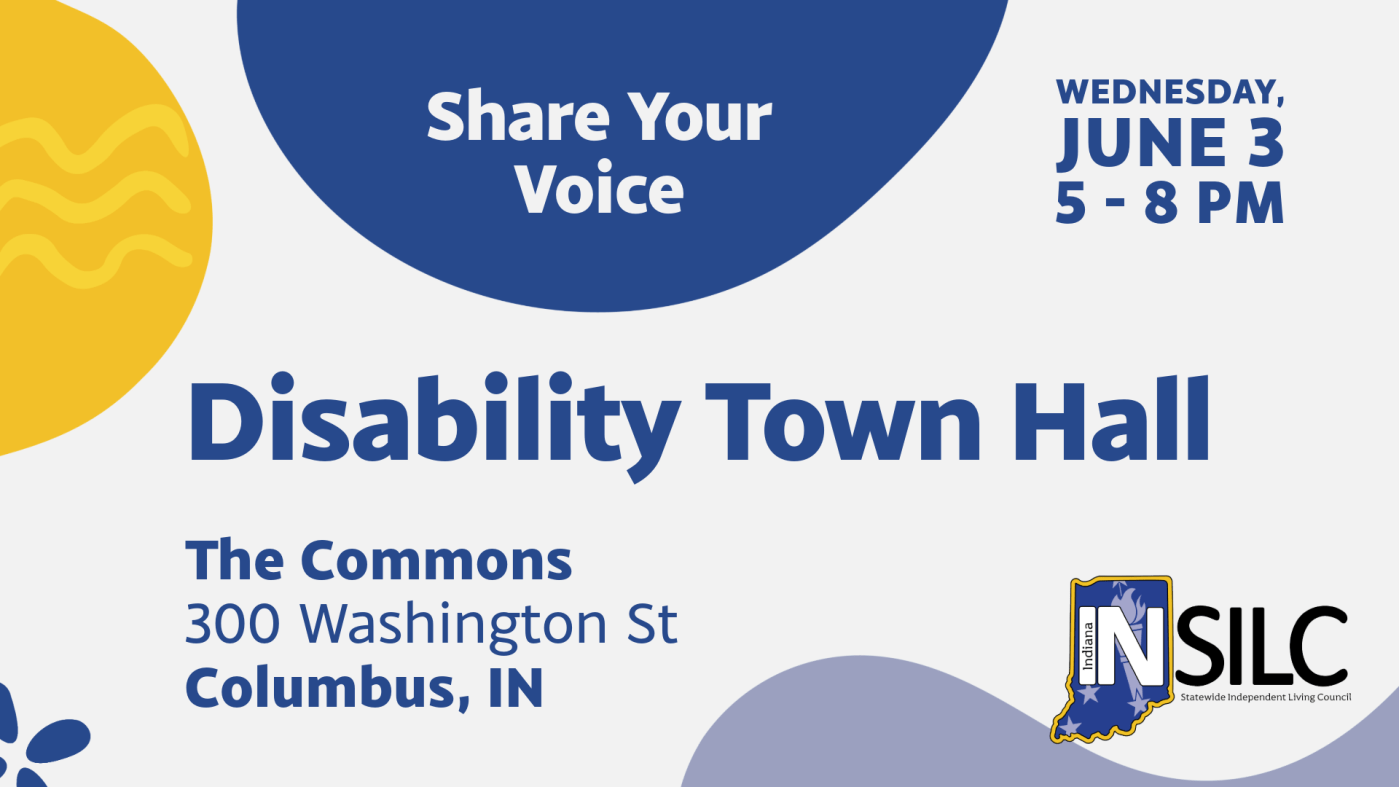
We learned a lot about what it’s like for folks with disabilities to negotiate the world we live in at the Columbus Disability Town Hall on June 3 at The Commons. The event was put on by the Indiana Statewide Independent Living Council and was emceed by Columbus City councilor Grace Kestler.
Several organizations that participated refer clients to their local township trustee’s office. So, as a candidate for trustee, I was extra interested.
Below are some topics of discussion, as well as some thoughts panelists and attendees had:
Barriers those with disabilities face:
*Attitude of the community. *Lack of information about disabilities. *Physical access. *Awareness of the needs of folks with disabilities. *Communication between people with disabilities, government officials, the general public. *The importance of clarity of speech for hearing impaired. *A shortage of accessible, affordable, and adaptable housing. *Understanding that a disability is not always obvious and that it can also be short-term.
Access to community life:
People with disabilities find their world shrinking as they sometimes become more isolated, which increases the possibility of depression. It’s critically imperative that we include people of all disabilities in our events and activities. People with disabilities are three to five times more likely to have depression than those without. We need members of the disability community to be more involved in planning events, so they can participate.
Government’s role:
The government shouldn’t look at accommodating those with disabilities as just checking a box because it’s a federal requirement. That’s not engaging with the community. Government officials need to get out of their offices and have conversations with people where they are. That’s a lot better than those with disabilities just going to a public meeting, where there is often limited opportunity or ample time to be heard. We need to do this especially with those whose voices are not often heard.
The city got the landlords together to talk about fair housing. That might not seem like community engagement, but it was since the landlords are people tasked with providing help.
We need to employ different ways of communicating with constituents, who get their information from varying sources. What’s best? Phone calls, email, social media, mailers, newspaper, radio, etc. It’s difficult to find one place everyone goes for their news these days.
Some government services don’t go far enough. One panelist had three people with disabilities who could not come to this event because their caregivers were not allowed to take them out due to Medicaid restrictions.
If healthcare is difficult to find, then employment could be hard to find. The same with housing.
The government can ask in proposals for events, services or buildings — what plans do you have to address disabilities?
For caregivers:
We need to make sure we address tools to deal with caregiver burnout. There are stress classes through Thrive Alliance and other resources. But some resources are lacking.
The government has been cutting a lot of funding to providers (our nonprofits), so we need to figure out how to deal with that.
Aging in place equals human dignity. The city has a housing improvement program (CHIP) where homes get rehabbed so that owners can stay there as they age.
Students:
IUC encourages students with disabilities to seek and get accommodations. Encourage parents and children to advocate for themselves at schools, even though sometimes it’s hard to get. You have to fight. When we treat kids with disabilities like others from the beginning of their lives, that they should be included, they expect it from the beginning. So, they expect to have accommodations.
When we invest in education, vocational schools, etc., that’s called investing upstream. It’s cheaper as a society to do that. You get less depression and mental health expenses later. The most expensive place to get health care is the Emergency Room. We want to take precautions ahead of time, so people don’t need to visit the ER.
Advice on something you can do now:
Contact elected officials and express opinions. Be more proactive in including everyone. J. I. Miller in 1964 said the goal is to make Columbus the very best community its size. We have to define what best is for ourselves. But for me, it’s to share with others. We need to check on those in our circles. We can’t check on everybody, but if everybody checks on those in our circles, we will be checking on a lot of people.
Miscellaneous:
Making sure you have accommodations for people with disabilities makes everything better for everyone. There are parents pushing strollers, people who are injured temporarily, and others who benefit from having accommodations, even though they may not have a permanent disability.
ADA (Americans with Disabilities Act) compliance is the bare minimum. We should go beyond that.
There are three elements that are the biggest keys to life: housing, healthcare, and employment.
The panelists:
Wendy Kirts, Executive Director, The Arc of Bartholomew County
Amber Scherer, Interim Executive Director, Thrive Alliance
Grace Kestler, City Councilor At-Large, City of Columbus
Jacob Sipe, Director of Community Development, City of Columbus
Kevin McCracken, Clinical Assistant Professor of Psychology and Mental Health Counseling, IU Columbus
Exhibitors:
- ADA Indiana
- Bartholomew County Public Library
- Bartholomew County Veteran Services
- Empowered Pathways
- Foundation for Youth
- Go Beyond Limits
- Indiana Governor’s Council for People with Disabilities
- REACH Columbus Inc
- Southern Indiana Center for Independent Living, SICIL
- Stone Belt Arc, Inc.
- The Arc of Bartholomew County
- Thrive Alliance
 Paul Hoffman for Columbus Township Trustee
Leave a comment